Thinking #likeJesus

Whose opinion really matters the most to me?

In Matthew 5 and Luke 6, we read Jesus’ Sermon on the Mount.  This comes right after Jesus selects the Twelve to be Apostles, so the content of his Sermon is a foundational piece to his training and preparation for them.

Again and again in his Sermon, Jesus says, “You have heard that it was said…”  He then follows with, “But I tell you…”  This is how others tell you you should live, but I want to introduce you to a whole new way of living!

He speaks this way about murder, reconciliation, adultery, divorce, taking oaths, revenge and loving enemies.

The wisdom of this world, the experiences and expertise of those with cred, the not so subtle messages from the media machine…  they all seek to shape us into their image.

Am I being “conformed” or “transformed?”  It all comes back to this.  Whose opinion matters most to me?

If I want to “walk as Jesus walked” then I need to listen to Jesus above all others.  I must learn to think like Jesus (as believers we do have the mind of Christ), so I can walk and talk like Jesus…  be Jesus with skin on in the world he’s placed me.


To learn more about Walking As Jesus Walked and Discipling As Jesus Discipled, visit:  SONLIFE.COM

Journey to Be #likeJesus

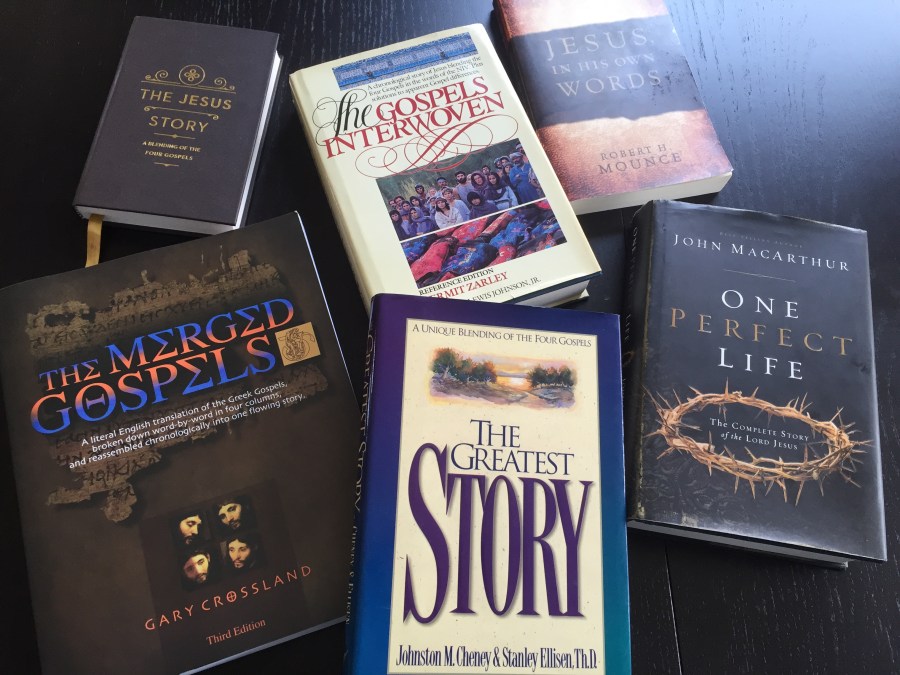
I began a journey in 2016.  A hunger to dive even deeper into the life of Jesus, a quest to discover what it truly means to live, love, lead, serve, speak, sacrifice, pray, prioritize and preach #likeJesus.  I committed to read through the Gospels every month this year. I’m taking a different Harmony of the Gospels, particularly those that weave the four gospels into a single narrative, and reading through each one over the course of a month.  Each day, I journal insights on what God is showing me about being #likeJesus.

I thought you might appreciate a brief description of the Harmonies I’ve read so far.

The Greatest Story by Johnston Cheney & Stanley Ellison  (JAN 2016)

Originally titled Life of Christ in Stereo, The Greatest Story represents the primary scholarship of Johnston Cheney, a layman who taught himself greek and spent the last twenty-plus years of his life compiling this work.  Stanley Ellisen, a professor of Biblical Literature from Western Seminary, lent his scholarship and helped to get the original work published.  One of Cheney’s unique arguments is that Jesus’ public ministry was a minimum of 4 years, not 3.  There are many things I appreciate about The Greatest Story, with both the translation and the blending of the four gospels making it very readable as a single narrative.

Jesus, In His Own Words  by Robert Mounce  (FEB 2016)

Robert Mounce offers a unique translation in Jesus, In His Own Words.  Everywhere the gospel writers, speaking of Jesus, say that “He said this” or “He did that,” Mounce translates it in the first person as if Jesus is telling His own story.  Robert Mounce is no slouch when it comes to his credentials to offer such a work, being the president emeritus of Whitworth University, a noted commentary author, and a translator of the New International Version, New Living Translation and English Standard Version.  From what I can tell, Mounce incorporates everything contained in the four gospels with the exception of Luke’s prologue (Luke 1:1-4) about writing an orderly account for Theophilus, since this is Luke’s own insertion and doesn’t fit the theme of Jesus, In His Own Words.

The Gospels Interwoven by Kermit Zarley  (MAR 2016)

Unlike others on this list, Kermit Zarley, a former professional golfer,  did not translate and harmonize The Gospels Interwoven directly from the Greek.  Instead, Zarley has taken the New International Version translation and woven it together into a single narrative.  To achieve his chronology, he took 13 different harmonies and laid them side by side to study the order in which they laid out the events of the life of Christ.  He leans toward the structure from Strong’s Harmony of the Gospels, which closely mirrors the timeline from Thomas and Gundry’s Harmony of the Gospels.  Having grown up with the NIV, the wording of The Gospels Interwoven  is very familiar and easily readable.  Harley has also included a helpful, extensive section that covers all the potential conflicts in harmonizing the gospels.  A very helpful tool!

One Perfect Life by John MacArthur  (APR 2016)

John MacArthur is a pastor, Bible teacher and author who has compiled a strong harmony. Having recently concluded his commentaries on all four gospels, MacArthur decided to compile  a single narrative Harmony  of the Gospels based on the chronological timeline he’s long used in his commentaries.  His translation closely mirrors the New American Standard Version, making it a little stiffer and less modern in its phrasing.  However, the inclusion of his commentary notes is very helpful and his chronology is solid.  I particularly found it refreshing that he began with a pre-gospel section where he wove together Old Testament scriptures regarding Creation, Fall, the Passover Lamb and Promises of the Coming Messiah.  Then he concluded with a post-gospel section with scriptures gathered from Acts, the Epistles and Revelation that emphasized the significance of the Death and Resurrection of Christ, the Return of Christ, Salvation by Grace through Faith and the need to Respond to the Gospel.

The Merged Gospels by Gary Crossland  (MAY 2016)

Gary Crossland has translated his harmonized gospel, The Merged Gospels, directly from the Greek and laid it out in a section by section, sentence by sentence format.  The layout has the feel of a workbook.  It’s wonderful for study and for seeing how each sentence and section was harmonized from the four gospels, but this makes it less readable as a story format.  One added benefit to Crossland’s work on The Merged Gospels is that it is also available in audio format.

NOTE:  One section of the harmonies that I use to compare each author’s work is how they treat the Call of the Four that we read in Matthew 4 and Mark 1.  Do they harmonize these together with Luke 5, or do they treat Luke 5 as a separate event where Jesus tells Peter a second time that he will fish for men.  I believe Matthew 4 and Mark 1 are a separate event from Luke 5.  Cheney, Mounce and MacArthur also harmonize the gospels this way, while Crossland and Zarley view the two accounts as different viewpoints of the same event.

The Jesus Story compiled by Bill Perkins

Bill Perkins has taken the classic, Life of Christ in Stereo by Johnston Cheney and Stanley Ellisen, and compiled it in a format that reads like a novel.  It’s in a nice hard-bound cover and laid out without scripture references or subject headings.  The seven sections of the book are Preparation for Ministry, The First Year of Ministry, The Second Year of Ministry, The Third Year of Ministry, The Fourth Year of Ministry, The Last Week of Ministry, and Crucifixion, Resurrection & Ascension.  It’s simple, meant to be read as a story, without the distractions or interruptions of scripture references or added commentary.

Other Harmonies that I will read later this year include:  The Harmony of the Gospels by St. Augustine of Hippo;  A Life Worth Knowing:  A Chronological Harmony of the Four Gospels by David Barrett; A Harmony of the Four Gospels: The New International Version by Orville Daniel; A Simplified Harmony of the Gospels by George Knight; The Fourfold Gospel by J.W. McGarvey; Eyewitness: The Life of Christ Told in One Story by Frank Ball.  I’ll provide a brief description of these Harmonies later in the year.

For study purposes, all of Sonlife Ministries’ training is based off Thomas’ and Gundry’s A Harmony of the Gospelswhich is a parallel version of the four Gospels, laid out in chronological order side by side.  Thomas’ and Gundry’s work also includes scholarly articles that provide an overview of various forms of biblical criticism and answers to the apparent challenges with harmonizing the gospels.


A Heart #likeJesus

Do we fully comprehend Jesus’ heart for us?  If we did, maybe it would change the way we prayed.  Prayer, at its most basic form, is asking.  What are you asking for from Jesus?

In Matthew 8, Mark 1 & Luke 5, Jesus heals a man with leprosy.  What a beautiful story of Jesus’ power and compassion.

When he saw Jesus, the man fell before him, and with his face to the ground, begged him on his knees, “Lord, if you are willing, you can make me clean.”

With his face to the ground…  can you feel his humiliation, brokenness and desperation?  How does Jesus respond?

Filled with compassion, Jesus reached out his hand and touched the man. “I am willing,” he said, “Be clean!”   Immediately the leprosy left him and he was cured.

Jesus was filled with compassion.  He did the unthinkable.  He touched the man.  How many years had it been since anyone touched his disease-ridden body?  Who would dare to do that?  No one!  But Jesus did!  And then we read some of the most beautiful words in all of scripture.  “I am willing.”  Three simple words.  But WOW, they tell us volumes about our Savior!

When I come to Jesus with my own humiliation, brokenness and desperation- often caused by sin- how does Jesus respond to me?

“I am willing!”

I am willing to walk with you through this.

I am willing to forgive you for this.

I am willing to heal you of this.

I am willing to restore you from this.

“I AM WILLING!”

That is Jesus’ heart for me.  That is Jesus’ heart for you.  Thank you, Jesus, for your extravagant grace.


To learn more about Walking As Jesus Walked and Discipling As Jesus Discipled, visit:  SONLIFE.COM

Angry #likeJesus

When is anger a good thing?  Can God use anger as a platform for His glory?

After Jesus’ first miracle where he turned the water into wine at the wedding feast in Cana in Galilee, Jesus traveled back to Jerusalem to celebrate the Passover at the Temple.

It’s here where we find Jesus furious with the money changers, making a whip out of cords, driving out the sheep and cattle, and upending the money changers’ tables.

It’s said of Jesus during this moment, “Zeal for your house will consume me.”

What else stirred Jesus up like this?  Off the top of my head, I can think of Jesus getting upset with the Pharisees for leading people astray and also Jesus being upset with his disciples for turning away the little children.  What else?

What stirs a righteous anger within me?  What kind of zeal consumes me?  Is it because of my Father that this anger is stirred, or is it me…  my own offense, my own pride, my own disappointment?

John 2 closes with this.  “Now while he was in Jerusalem at the Passover Feast, many people saw the miraculous signs he was doing and believed in his name.”

Wow, what a week that must have been!  Jesus causes an uproar by driving out the money changers and performs many miraculous signs, likely healing people and casting out demons.

Everyone in Jerusalem, including the religious elite like Nicodemus, had to be thinking, “Who is this man?!”

Anger can be as much a demonstration of God’s power as miracles are, if the anger is a righteous stand against wickedness or oppression of the weak.

Does what I stand for and how I carry myself (both my words and actions) cause “many people to… believe in His name?”


To learn more about Walking As Jesus Walked and Discipling As Jesus Discipled, visit:  SONLIFE.COM

Great #likeJesus

What does Jesus think of me?  We know what He thought of John.

John the Baptist prepared the way for Jesus.  He was the “forerunner.”  What do we know about John that prepared him for this?

John was Jesus’ second cousin, only six months older than Jesus.  John’s birth was considered a miracle since his parents were old and his mother, Elizabeth, was barren.   John’s father, Zechariah, was a priest.  He was highly respected.  Zechariah and Elizabeth were godly parents, upright in the sight of God, obedient, blameless.

John “leaped in the womb” when Elizabeth met Mary, pregnant with the Savior.

John “grew and became strong in spirit; and he lived in the desert until he appeared publicly to Israel.”  Because of this, there is speculation that John was raised among the Essenes, a Jewish religious group that lived in the desert, following a monk-like lifestyle.  John would have been trained and commissioned to be a Rabbi since he had his own disciples.

God not only prepared John through his upbringing, but also by speaking to him directly.

“The word of God came to John…”

“He came as a witness to testify to the light, so that through him all men might believe.”

John’s character, actions and message caused many to believe he was the Messiah.  People came from Jerusalem and all Judea and the whole region of the Jordan to see him.

John’s character was blameless, humble (I’m not worthy) and simple (clothes of camels hair, food of locusts and wild honey).

John’s actions were righteous.  He stood up to the hypocritical religious elite.  He stood up to those in political power.  He baptized many who were repentant.

John’s message was powerful, clear and direct.  He preached a baptism of repentance for the forgiveness of sins.

“Repent, for the kingdom of heaven is near.”

“Produce fruit in keeping with repentance.”

“Make straight the way for the Lord.”

I’m personally challenged by John’s life.  I want my character, actions and message to bring maximum glory to God and impact for His kingdom.

I’m also challenged as a father by Zechariah and Elizabeth.  The impact of their lives as parents, raising John in such a way that God would use him as He did.  What am I doing to intentionally raise my own “John the Baptists?”

And what did Jesus think of John?  Jesus said, “Truly I tell you, among those born of women there has not risen anyone greater than John the Baptist!”

John was a great man.  He was used greatly by God.  He was dedicated to and dependent upon his Great God!  He was called and committed to a Great Mission!  He pursued and proclaimed a Great Message!  He sought after and served humbly his Great Master!

That’s the kind of greatness I aspire to.


To learn more about Walking As Jesus Walked and Discipling As Jesus Discipled, visit:  SONLIFE.COM

Sent #likeJesus

From the very beginning of His story, we see the “sent-ness” of Jesus.

The angels’ words to Mary, Joseph and the shepherds are packed with meaning in what they reveal about Jesus’ identity.

To Mary:

“You will give birth to a son”

“Give him the name Jesus”

“He will be great”

“He will be called the Son of the Most High”

“He will be given the throne of his father David”

“He will reign over the house of Jacob”

“His reign will never end”

He’s the “holy one”

“He will be called the Son of God”

To Joseph:

“What is conceived in her is of the Holy Spirit”

“Give him the name Jesus”

“He will save his people from their sins”

To the shepherds:

“Good news of great joy for all the people”

“A Savior has been born”

“He is Christ the Lord”

“Glory to God”

“Peace to men on whom his favor rests”

So what do we learn from the angels?

  • We learn of Jesus’ deity (Son of the Most High, Son of God, Lord, conceived of the Holy Spirit).
  • We learn of Jesus’ character (great, holy).
  • We learn of Jesus’ position and authority (throne of David, reign will never end, Christ the Lord).
  • We learn of Jesus’ mission (save his people from their sins, the Savior, the Christ).
  • We learn of Jesus’ impact (He will reign, bring great joy, bring glory to God, bring peace to men).
  • We learn who Jesus came for (good news for all people).

Also from the angels…  implied, but evident still, we learn of Jesus’ humanity (YOU will be with child, you will give birth to a SON, she will give birth to a son).

It was a mystery to Mary and Joseph, God being born as a man, Mary’s son.  Jesus is fully 100% God, yet also born fully 100% man.  Our puny little minds can’t comprehend that.

But since sin entered the world through Adam- a man, the father of the human race- our sin nature is passed on to us through Adam.  Because Jesus didn’t have an earthly father to inherit a sin nature from, He was born without sin.  This allowed him, through a life of obedience to the Father, to remain without sin until his death on the cross.  This qualified Jesus to pay for our sin…  he didn’t have his own sin to pay for.  He alone was qualified to go to the cross for us…  and we trace that back to His virgin birth.

Jesus was sent for me!  He is all of this, has accomplished all of this, for me!  The Father sent His Son for me!  Jesus was sent to be my Savior, my Lord, my King, and yet my Friend!  Oh, what a Savior!!!


To learn more about Walking As Jesus Walked and Discipling As Jesus Discipled, visit:  SONLIFE.COM


#likeJesus Grandeur

How much do we love Jesus?  Do we express our profound appreciation for and marvel at His majesty, His grace, His grandeur, His beauty?

In Kermit Zarley’s Harmony, The Gospels Interwoven, he begins with John’s Gospel.

“In the beginning was the Word, and the Word was with God, and the Word was God.”

Moving beyond John’s introduction to the account of Elizabeth and Mary, cousins who had been chosen by God to bear John the Baptist and Jesus, I am struck by the beauty of Mary’s song recorded in Luke 1:46-56.

“My soul glorifies the Lord and my spirit rejoices in God my Savior, for He has been mindful of the state of His servant.  From now on all generations will call me blessed, for the Mighty One has done great things for me- holy is His name.  His mercy extends to those who fear Him, from generation to generation.  He has performed mighty deeds with His arm; He scattered those who are proud in their inmost thoughts.  He has brought down rulers from  their thrones but has lifted up the humble.  He has filled the hungry with good things but has sent the rich away empty.  He has helped His servant Israel, remembering to be merciful to Abraham and his descendants forever, even as he said to our fathers.”

Mary was amazed by Jesus.  She was amazed by the honor of being chosen.  She was amazed by God’s grand plan.

Today, Father, as I walk with you, I want my soul to glorify you.  I want my spirit to rejoice in you.  I want to recognize how you’ve been mindful of me, how you’ve blessed me.  You are holy.  You are mighty.  You have done great things for me.  Extend your mercy to me.  I want to stay humble and hungry.  You are a God who remembers.  You keep your promises.  I will trust you.  I will obey you.  I will love and honor you.


To learn more about Walking As Jesus Walked and Discipling As Jesus Discipled, visit:  SONLIFE.COM

Burning Hearts #likeJesus

Can you imagine spending two hours walking and talking with Jesus?  What would you talk about with Him?  Or better yet, what would He talk about with you?

After the Resurrection,  Jesus found two of His disciples (Cleopas and his companion) traveling on the road from Jerusalem to Emmaus.  They’d heard reports about the Resurrection but still struggled to believe.

Along the way, Jesus explained the Scriptures regarding the coming Messiah.  Later that day at one of their homes, He broke bread with them.  Their eyes were opened.  They now realized it was Jesus they had been with.

I love their response.  “Didn’t our hearts burn within us as He talked to us!”  Immediately they went to tell the Apostles.

When we spend time with Jesus, do our hearts burn within us?   They should.  And when they do, our response will be unavoidable.   We’ll go and tell!


To learn more about Walking As Jesus Walked and Discipling As Jesus Discipled, visit:  SONLIFE.COM

Seeing Family #likeJesus

What was Jesus’ impact on his family?

In harmonizing Matthew 27:55-56, Mark 15:40-41, Luke 23:49 and John 19:25-27, Robert Mounce draws an interesting conclusion I’d never heard before regarding the women at the crucifixion.

Matthew identifies the women as Mary Magdalene, Mary the mother of James and Joseph, and the mother of Zebedee’s sons.

Mark identifies them as Mary Magdalene, Mary the mother of James the younger and Joses, and Salome.

Luke identifies them merely as “the women.”

John says that near the cross stood Mary, the mother of Jesus, and Mary’s sister.  Also there were Mary the wife of Clopas and Mary of Magdala.

Harmonizing these accounts, Robert Mounce believes that the mother of Zebedee’s sons (James and John) was the woman named Salome, and that she was the sister of Mary (Jesus’ mother).

This would make James and John, the Sons of Thunder and two of his first followers and closest friends, Jesus’ cousins.

This possibility raises all kinds of questions…

How well did James and John know Jesus before his baptism?

Had they heard “stories” about his birth and wondered who his real father was?

Did they have any idea he could be the Messiah?

Were they more trusted because Jesus knew them already, at least as relatives?

Were they quick to believe and follow because they already knew Jesus and had a sense of family loyalty (this certainly wasn’t the case with his half-brother, James)?

Is this why Jesus’ disciples were invited to the wedding in Cana?  Were they extended family of the bride or groom, just as Jesus likely was?

Is this why Jesus asked John to care for Mary after his death?

When Jesus is told that his mother and brothers are outside  the house and want to see him, and he replies by asking, “Who are my brothers and mother?”  how would James and John have felt when Jesus asked this question about their Aunt Mary and then pointed at them and the other disciples and said they were his family?

Things that make you go “Hmmmmm?”

What is the impact our life has on those closest to us… on our friends, our parents, our brothers and sisters, our cousins, our aunts and uncles, our grandparents?  Does our life inspire those closest to us to passionately pursue Jesus?


To learn more about Walking As Jesus Walked and Discipling As Jesus Discipled, visit:  SONLIFE.COM

Marked #likeJesus

What mark has the cross made on my life?  Yes, through the power of the cross, I’ve been offered forgiveness and eternal life through Christ.  But what about the weight of the cross?  Do I feel the weight of the cross each day?  How does the weight of the cross change the way I live?

The African, Simon the Cyrene, who was pulled from the crowd to carry Jesus’ cross, was a father of two sons, Alexander and Rufus.  Why is this mentioned?   Why do we know their names?   How would this event impact these three men?

Cyrene was in Libya in North Africa.  It was a Greek colony where 100,000 Jews had been forced to settle.  It would become an early center of Christianity.

Acts 11:20 speaks of “men of Cyrene” who preached the Gospel to the Greeks.  This could have been Simon, maybe even his sons.

In Romans 16:13 Paul mentions Rufus, “chosen in the Lord, and his mother, who has been a mother to me too.”

Tradition states that Rufus and Alexander became missionaries.

Simon shared in the sufferings of Christ.  He experienced the cross.  He felt the weight of it.  He witnessed the Savior obediently giving up his life.

Encountering the power of the cross transforms people.  How could it not transform Simon?   How could it not transform his family?

Is it this simple?   The closer we get to the cross, the more we feel its weight, the more it transforms us.

I want my life to be marked by the weight of the cross.  I want it to be felt in the decisions I make, the words I speak and the steps I take.

Then Jesus said to his disciples, “Whoever wants to be my disciple must deny themselves and take up their cross and follow me.”   Matthew 16:24


To learn more about Walking As Jesus Walked and Discipling As Jesus Discipled, visit:  SONLIFE.COM